Weekend experiment
Cal
A visual agenda that brings plans, places and times onto one timeline.
Cal explores whether an evening can be understood as a whole rather than assembled one listing at a time.
Open Cal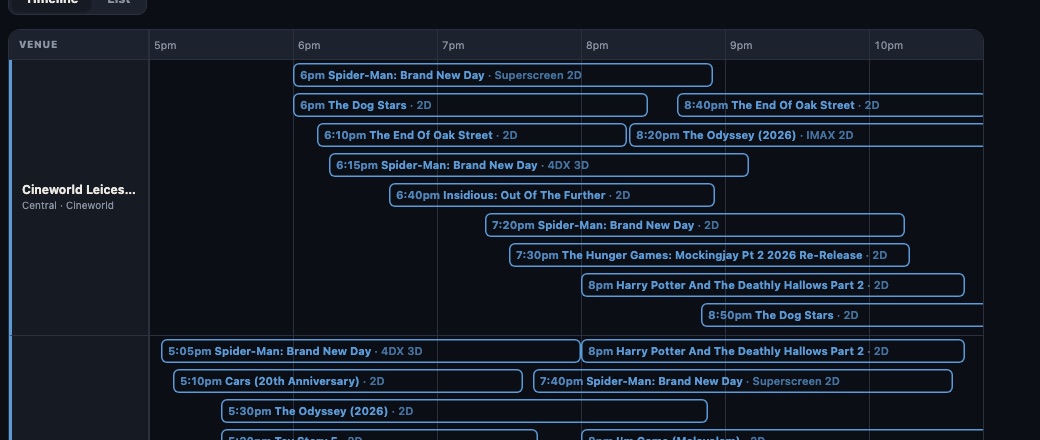
Prad Pokuri · Senior AI platform engineer
At Bloomberg, I work on AI platforms and infrastructure. I’m interested in what it takes to move from a compelling model demo to a system people can use, trust and improve.
02 / CURRENT FOCUS
The hard part is rarely getting a model to do something impressive once. It is fitting AI into a real workflow—with the right data, tools, permissions, evaluation, failure handling and human judgment. That is the part of the stack I care about most.
03 / SELECTED EXPERIMENTS
Over one weekend, I used Claude Code to take two product ideas from rough concept to working software. The goal was rapid learning, not production readiness.
AI compressed the implementation time. It did not remove the need for product direction, visual judgment, testing or the engineering required to make a system dependable.
Weekend experiment
A visual agenda that brings plans, places and times onto one timeline.
Cal explores whether an evening can be understood as a whole rather than assembled one listing at a time.
Open Cal
Weekend experiment
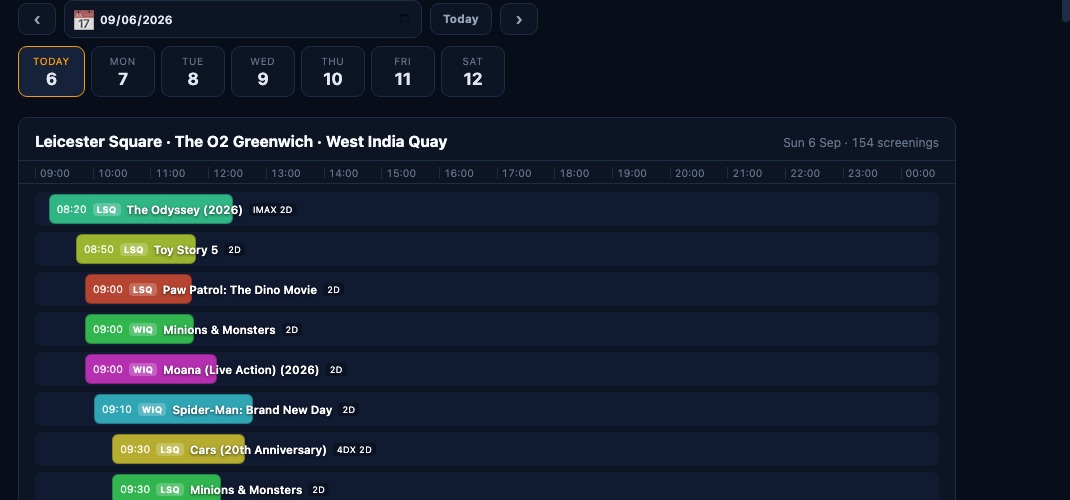
A cinema listings board organised around time.
Cine makes it easier to compare films, cinemas and showtimes without opening a chain of separate listings.
Open Cine04 / HOW I THINK
A model is only one component. I start with the workflow and the uncertainty that matters.
01
What are people trying to accomplish, where does the current process break, and what role—if any—should AI play?
02
Test the assumption that could make the rest of the project irrelevant before investing in the full system.
03
A narrow end-to-end prototype usually teaches more than a polished demonstration isolated from the real workflow.
04
Consistency, permissions, bad cases, latency, cost and human review matter more than the model’s most impressive response.
05
A useful prototype earns the next question. It does not answer questions about security, reliability, operability or organisational ownership.
05 / EXPERIENCE
My background spans product-facing engineering, startups, enterprise infrastructure and engineering leadership. That range has made me wary of both strategy that never touches reality and prototypes that are mistaken for systems.
I like working between the two: close enough to the code to build, and far enough back to see the broader technical and organisational problem.
More about my work06 / SMALL TEAMS
Outside my day job, I occasionally have informal, pro-bono conversations with small firms exploring AI. The most useful work is usually clarifying the workflow, identifying the riskiest assumption and deciding what evidence would justify building more.
Get in touch07 / BEYOND WORK
I’m Indian, grew up between Jamaica and Atlanta, and have spent much of my life moving between different cultures, religions and kinds of music. There is more to me than platforms and prototypes.
Life outside work